
By Allan M. findlay
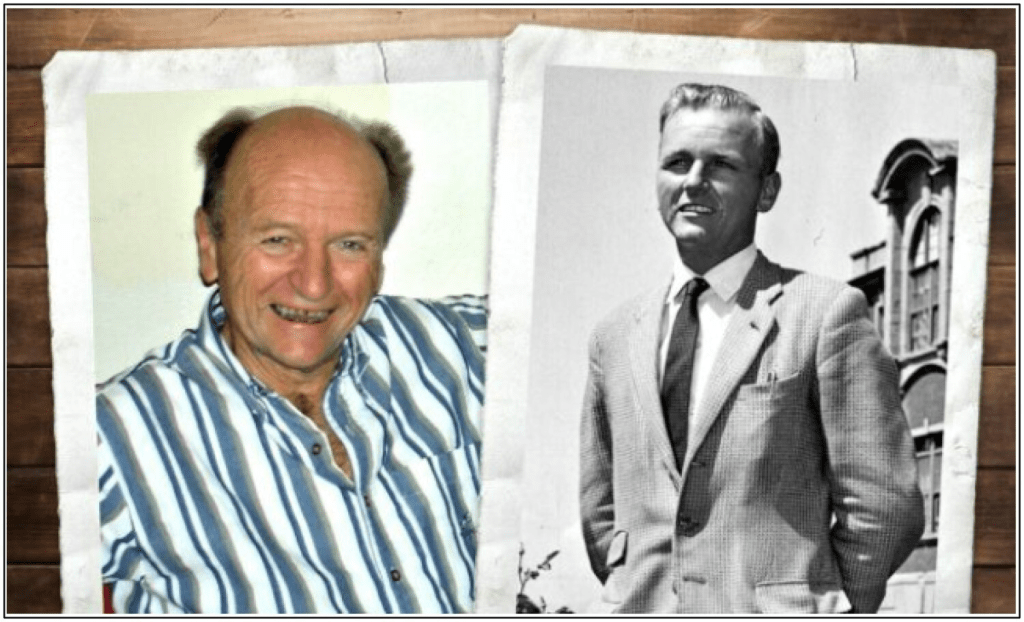
Figure: Huw Jones, older and younger. (Source: Family photograph, reproduced with permission; also from Obituary published in The Courier [Dundee] 14/07/2023, available electronically at: https://www.thecourier.co.uk/fp/news/dundee/4557922/professor-huw-jones-dundee/).
Professor Huw R Jones (1937 -2023)
With the death of Professor Huw Jones in July 2023, the academic community has lost someone who was an outstanding advocate for the discipline of Geography and who was very dedicated to advancing and shaping the subdiscipline of Population Geography. His friends and colleagues will also remember Huw Jones as a man who was, at one and the same time, a proud Welshman and a strong defender of his adopted home city of Dundee. Dundee was where he lived and worked for more than 40 years as University lecturer, Professor, Head of Department and also Faculty dean.
After Huw Jones graduated with a first-class degree from the University of Aberystwyth (part of the University of Wales), he moved to the University of Leicester for postgraduate study. He was then briefly a visiting lecturer (as pictured on the right above) in British Columbia, Canada, before returning to the United Kingdom in 1961 to take up a permanent university lectureship in Dundee.
Huw Jones’s early research examined the processes shaping internal migration in Wales and Scotland (Jones, 1965, 1967a, 1967b). In line with leading geographical research of the time, his focus was on testing hypotheses about migration regularities, as well as explaining how migration processes were structured and in turn shaped the character of places of out-migration as well as of in-migration (Jones, 1968, 1970, 1974, 1976; Jones & Davenport, 1972). Recognition of the high quality and impact of his research is evident from the fact that in the first 15 years of his career he had four of his papers accepted by the Transactions of the Institute of British Geographers (the premier place for a UK-based geographer of his generation to publish research) (Jones, 1965, 1970, 1973a, 1976).
With his identity established as a population geographer, Huw Jones diversified his research focus becoming one of the earlier population geographers to explore spatial dimensions of fertility as well as analysing the triggers of fertility decline (Jones, 1975, 1977a, 1977b). It was in this early phase of his career that he started treating small island nations as a useful laboratory for analysing the time–space nexus of population change. Numerous research papers followed on Malta, Gozo, Barbados and Mauritius (Jones, 1971, 1972a, 1972b, 1973b, 1989a, 1989b, 1993a).
Thus far, most of this tribute has focussed on Huw Jones as a researcher. It is, however, important also to celebrate Huw’s dedication as a lecturer. I was privileged to be one of Huw’s colleagues at the University of Dundee for most of two decades. I therefore was able not only to observe the enthusiasm for geography that he inspired in his students, but also to hear many tales of the adventures he and other colleagues enjoyed while leading field trips to Malta and other Mediterranean destinations. In turn, his desire to provide high-quality teaching resources to his students proved a trigger to him writing what became the defining population geography textbook of the 1980s and 1990s (Jones, 1981). This book, Population Geography, probably more than anything else, established his global status as an eminence grise of the sub-discipline. He went on to produce a significantly revised version of this very popular text (Jones, 1990). At a local level, the book impacted the Department at the University of Dundee by attracting many international students to come to Dundee to undertake PhDs, as well as a very welcome stream of visiting academics from around the world.
By the late-1970s, Huw Jones had become a leading figure within the Institute of British Geographers (later known as the Royal Geographical Society with the IBG). He became secretary to the Population Geography Study Group (1977–1979) of the IBG, reporting annually in the journal Area about the conference activities of the group and laying out the research vision of British population geography (the group was later retitled the Population Geography Research Group).
He was also invited by Professor John Clarke (then Chair of the Population Commission of the International Geographical Union) to become the academic voice defining the nature of British population geography. Huw Jones used this opportunity to offer an insightful but also critical review of the state of population geography in the early 1980s, which proved influential in at least two ways. First, he was one of the first to reject attempts to establish ‘a comprehensive paradigm to provide a theoretical frame to order information within the domain of population geography’ (Jones, 1984b, p. 177). Instead, he advocated ‘population geographies’ in the plural, and recognised the value of pluralistic perspectives. Second, he signalled to members of the subdiscipline the need to form research teams. He noted that most population geographers worked in small departments where they were the only representative of the subdiscipline (Jones, 1984b, p. 172). With the advent of increasing computing power and population geography’s strength in using large census datasets, he argued that there would be great benefits in research team collaboration, bringing together academics with methodological strengths alongside those whose research was theory-led. Applying this insight in his own context, Jones established two research teams. Not surprisingly, one had a population focus, researching topics such as counter-urbanisation (Jones et al., 1984b; Jones et al., 1986) and migration trends/population change in Scotland (Jones, 1982, 1984a, 1986, 1992a; Jones et al., 1984a). The other early research collaboration involved deploying geographical information systems to examine the causes underpinning patterns of crime (Jones, 1993b; also Berry & Jones, 1995; Jones & Berry, 1993; Jones et al.,1991, 1994). Research group leadership therefore became a hallmark of Huw Jones’s contribution, both at an institutional and a disciplinary level. It was rewarded not only by his appointment to a personal chair in 1993, but also by considerable institutional investment in the Department of Geography at the University of Dundee (Findlay & Werritty, 2010). In due course the population cluster expanded to become the Centre for Applied Population Research, with its own research paper series (Findlay et al., 1997; Jones, 1997; Jones & Pardthaisong, 1997; Li et al., 1998a) and a focus for research by a significant number of staff, research fellows and postgraduate students.
While serving as Head of Department and later as Dean of the Arts and Social Science Faculty, Huw Jones’s disciplinary research contribution took two new turns. First, he accepted the role (with Bob Woods) as editor of population geography’s newly-established journal, the International Journal of Population Geography (later retitled Population, Space and Place). McCleery (2003, p. vi) has described how under his editorship the journal quickly became the international flagship for the subdiscipline. With the benefit of hindsight, others have evaluated the editors’ ambitions to make the journal ‘the most influential outlet for research in population geography’ (Woods & Jones, 1995, p. 1) and have provided useful retrospective appreciation of the contribution of the journal in shaping the subdiscipline (Botterill & Philo, 2023).
The second significant turn in Huw Jones’ work in the 1990s was to switch his research focus to international migration. In contrast to a few earlier pieces of research on emigration to Canada and aspects of immigration to Australia (Jones, 1979, 1992b, 1994, 1995), his new interest on Pacific Asia adopted structuralist and structurationist perspectives. Working with Thai colleagues, he explored the commodification of international migration in the region, in particular looking at the role of international recruitment agencies in shaping international migration geographies. Research in Hong Kong, Thailand, Singapore, the Philippines, and Japan illustrated how migration was ‘produced’ across the Asia Pacific region in response to the international economic forces shaping global labour markets (Findlay et al., 1998; Jones, 1992b, 1998, 2003a; Li et al., 1998a, 1998b). He made multiple research trips to Thailand, based frequently at Mahidol University, Chiang Mai, working with his good friend and fellow academic, Tieng Pardthaisong. With Pardthaisong and other colleagues, he explored many other demographic dimensions of Thailand, such as the interaction between fertility decline, out-migration and AIDS (Jones & Pardthaisong, 1999a, 1999b, 2000; Jones, 2003b; Jones & Kittisuksathit, 2003).
Given Huw Jones’s immense contribution to the discipline of geography, including in Scotland (Dawson et al., 2003) and in particular to the subdiscipline of population geography, it was fitting that the close of his career at the University of Dundee was marked by the publication of a special issue of the Scottish Geographical Journal (Volume 119(3)) in his honour. In her guest editorial, the editor (McCleery, 2003, p. vi) saluted Huw Jones ‘in recognition of his outstanding achievement’. With his passing we salute him once more, recognising the immense contribution that he made and the privilege that many of us had in sharing part of his academic journey.
Acknowledgments
Many thanks to Gareth Jones for his generous assistance and permission for Figure 1, and also to Chris Ferguson of The Courier for putting us in touch with Gareth.
This tribute first appeared in the Scottish Geographical Journal in April 2024, written by Allan Findlay and has been re-produced with the kind permissions of Chris Philo, Editor-in-Chief.
To cite this tribute: Allan M. Findlay (29 Apr 2024): Professor Huw R Jones (1937–2023), Scottish Geographical Journal, DOI: 10.1080/14702541.2024.2342505
 Population Geography