
By Paula Duffy, University of Aberdeen
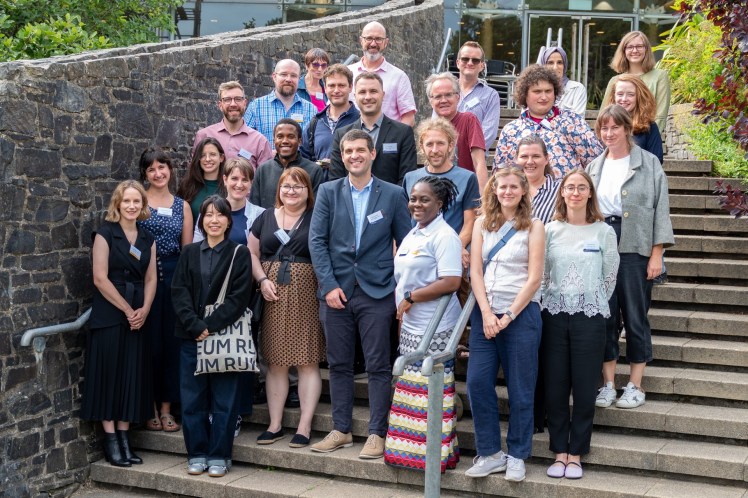
The fourth International Migration and Mobility Conference (iMigMob 2025) brought together migration scholars from geography and beyond to the picturesque setting of Aberystwyth University from 8-10 July. The Sun was shining on Aberystwyth, matched by the warmth of Welsh hospitality and an intellectual energy and critical engagement that permeated the three days of presentations, discussions, and debates.
The conference’s three keynote speakers delivered thought-provoking presentations that challenged fundamental assumptions about the migrant, migration governance and categorisation as well as our own research praxis. Dr Giovanni Bettini opened proceedings with his exploration of “climate nomadism,” but his provocations went deeper than reimagining future mobility scenarios. Bettini issued a call to rehumanize the migrant, consciously questioning who holds agency, what constitutes subjectivity, and foregrounding the embodied experiences of those displaced by climate crisis. Rather than simply extending current inequitable geographies of displacement into an even more dire future, his intervention challenged us to consider the political subjectivity of those on the move and to think beyond the deadlock of dominant discourses around climate migration.
Professor Michaela Benson’s keynote on migration and the making of ‘Global Britain’ offered a bold analysis of how the post-Brexit migration-citizenship regime interweaves coloniality and geopolitics. Her examination of state-making through migration governance revealed the contradictions and contingencies that shape contemporary British immigration policy. Particularly compelling was her exploration of how UK humanitarian visa types have seen a reshuffling of migrant status and belonging, effectively redrawing ‘safe and legal routes’ outside of the international refugee regime.
Dr Sophie Cranston concluded the keynote series by questioning the depoliticised category of the ‘international student,’ examining not only who international students are and how they are defined, but crucially how they are constructed in relation to the ‘public’ and ‘taxpayer.’ Her archival work traced this relationship from the 1962 Education Act’s conception of education as a public good through to today’s higher education funding crisis. Cranston demonstrated how categorisation processes have long been embedded within post-colonial political economies, revealing the economic imperatives that drive these supposedly neutral administrative categories.
What emerged powerfully across the presentations was a series of interconnected themes that transcended traditional disciplinary boundaries and were echoed in the parallel sessions. Particularly striking were the continuities around questions of governance, belonging, and the politics of movement.
The geographic scope spanned from local studies of demographic change in rural Monmouthshire to global analyses of cryptocurrency remittances to Venezuela. Yet despite this diversity, common analytical threads emerged around agency, temporality, and the contested nature of belonging. Papers examining “restanza” among Welsh speakers, the experiences of returning Rwandese and Ugandans after German apprenticeships, all grappled with how individuals and communities navigate imposed categories while asserting their own forms of agency.
Looking Forward, It was clear that this conference series continues to fulfil its founding mission of cultivating diverse disciplinary perspectives while spotlighting intersections between demographic research and broader mobilities scholarship. The Aberystwyth gathering demonstrated the vitality of migration geography while pushing us to think more critically about the categories we use, the futures we imagine, and the governance structures we too often take for granted.
The conference reminded us that in our rapidly changing world, the questions we ask about migration and mobility are as important as the answers we provide.
The Population Geography Research Group was pleased to support the iMigMob25 conference through a small number of Early Career Researcher bursaries, enabling emerging scholars to participate in this vital academic dialogue. The bursary recipients will be sharing their own reflections on the event in upcoming blog posts – please follow along for more insights from the next generation of migration and mobility scholars.
 Population Geography