
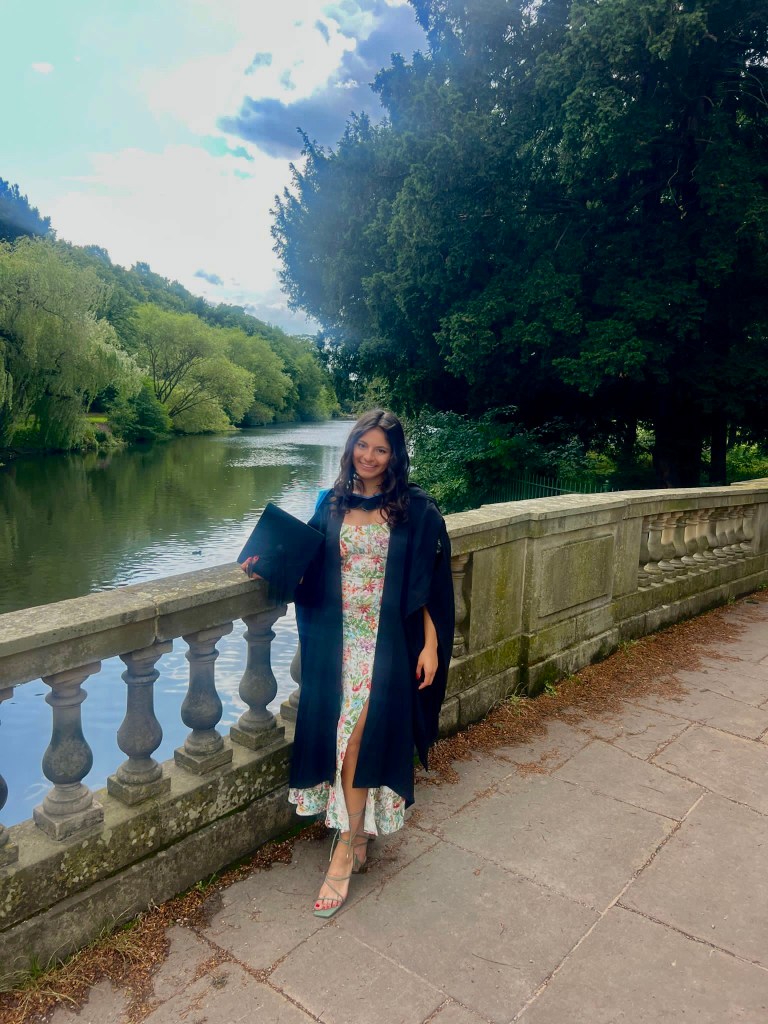
Each year undergraduates are pushing new boundaries in population geographies and this years nominees were no different . The dissertations were exemplary, across a breadth of topics utilising a variety of research methods. They each highlight the excellent work and bright future of the sub-discipline. In recognition of this we offer the Joanna Stillwell Prize to an outstanding undergraduate dissertation project in the field of population geographies and we are pleased to announce the 2023 prize winner as Emanuella Lorente for her dissertation: Gender and Gentrification: Feminist perspectives on Contemporary Inner- City Neighbourhood change in Southwest London.
My name is Emanuella and I recently graduated with a Bachelor of Science in Geography, from the University of Nottingham. I initially came to the University to study Physical Geography but quickly became fascinated with the exploration of justice and inequalities in my optional Human Geography Modules. Throughout my degree I often found myself captivated in the readings of Feminist Geography and especially interested in the multiple ways that geographical thought can disentangle interactions across various topics and scales, encouraging me to shift the focus of my degree to pursue a Human Geography dissertation.
Growing up in a diverse London borough as a mixed-heritage British young woman I have often found myself struggling to grasp gendered challenges of safety in public space. This increased when my area began to gentrify, as my place attachment and feelings of fear became conflicts of interest. Noticing these changes, I became increasingly interested in the social and spatial contexts of fear and its relation to place attachment, hence inspiring my dissertation “Gender and Gentrification: Feminist perspectives on Contemporary Inner- City Neighbourhood change in Southwest London.”
I wished to undergo an in-depth ethnographic study focusing on urban fear, to explore how women’s geographies of fear are shaped by gentrification in the Tooting, Balham and Clapham neighbourhoods. Thus, I used Feminist Geography as a method of analysis on multiple scales, facilitated through an intersectional analysis of the much-studied topic of Gentrification, to dismantle existing narratives of urban geography but to also centre on the agency and voices of those marginalized by hegemonic discourses, in the hopes of gaining new perspectives of urban change in relation to women’s fear and their experiences of place.
A thorough analysis compiled from the combination of interviews, creative field diaries and secondary research ensured I was able to access a range of perspectives, not just from different classes but also race, which has been ignored in many definitions of gentrification. I explored a range of ideas, including gentrification as a ‘coping strategy’ for many women, the commodification of safety and women’s ‘right to the city’, to ultimately highlight the inequalities women face due to unequal social power relations, and the need to rework and renegotiate gender in urban space.
Overall, my study examined how gentrification makes places liveable for a selective group of people, affecting others disproportionately, enabling ‘right to the city’ for some women, but not all, and at the cost of others. Thus, I was able to understand how gentrification is about the politics of urban space: who the city is for, who is empowered and who is marginalised.
As a recent graduate, I plan on doing some travelling and saving for a Masters I hope to pursue in 2024.
 Population Geography